
The second year of Targa Newfoundland nearly doubled the car count as word of the event spread. Competitor Tim Winker wrote about his adventures with driver Scott Giannou in Targa 2003.
Targa Newfoundland 2003
By Tim Winker, VintageRally.com
VintageRally.com – The Source for Vintage and Historic Auto Rally Information
Monday, Sept. 15, 2003
As a competitor in last year’s inaugural Targa Newfoundland, I am considered a “pioneer”. Those who followed last year’s event may recall that there were 35 entries. This year the count is more like 60, and over a third are among the pioneers. That’s a damn good return rate!
There is good reason for it… Targa Newfoundland is one great event!
Word of the success of TN’s first year has spread among automotive adventurers across North America, and elsewhere, and they don’t want to miss out again.
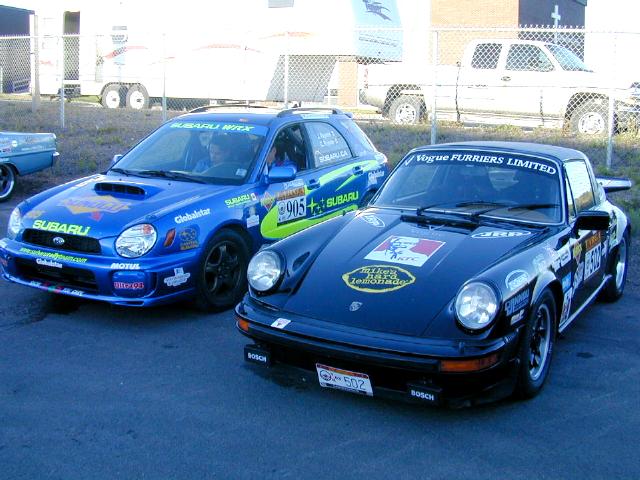
Jerry Churchill is back, though not with the mighty V10 Dodge Viper he ran in ’02. Instead he has a Subaru WRX built for ProRally, which should do better on these roads despite the smaller engine. In fact there are quite a few Subarus, most WRX’s, including one entered by Subaru of Canada for brothers John and Clark Paynter. Porsche is the Honoured Marque this year, and there are a flock of those as well, and the whole event will be preceded by a Porsche Cayenne SUV as Course Opening Vehicle.
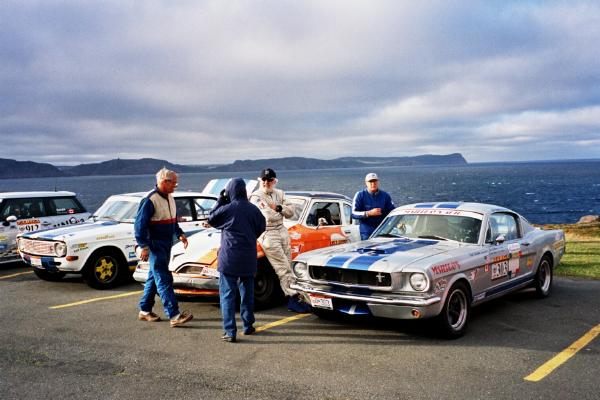
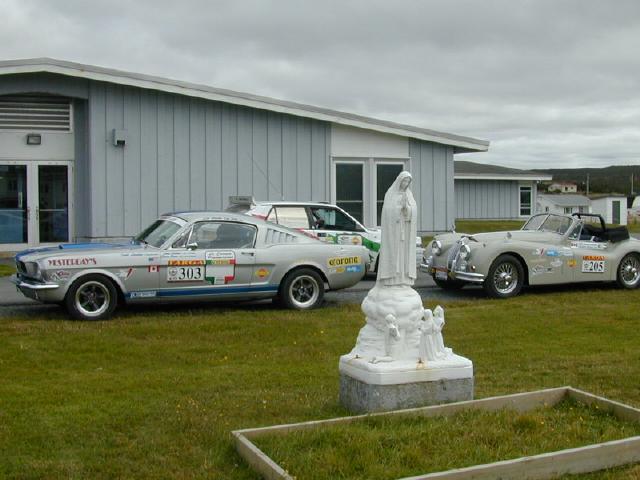
Australian Ralph Grant is entered again, though this time it’s in his own Volvo 142. Canadian Jodie Shay is Grant’s co-driver. Bill Arnold won the Modern class in his BMW M Coupe in 2002, but he’s back in a 1972 BMW Bavaria sedan in the Classic division, though the powerplant is a much newer “M” six cylinder. Jeremy Hill and Lennox McNeely return in Len’s 1965 Ford Mustang Fastback, hoping to better their runner-up finish of last year.
A couple veterans of Mexico’s La Carrera Panamericana made the trip to eastern Canada this year: Tom Silver and Dave Fuss in another ’65 Mustang Fastback, and Tom Hayes and Andy Vann in a highly modified ’53 Studebaker.
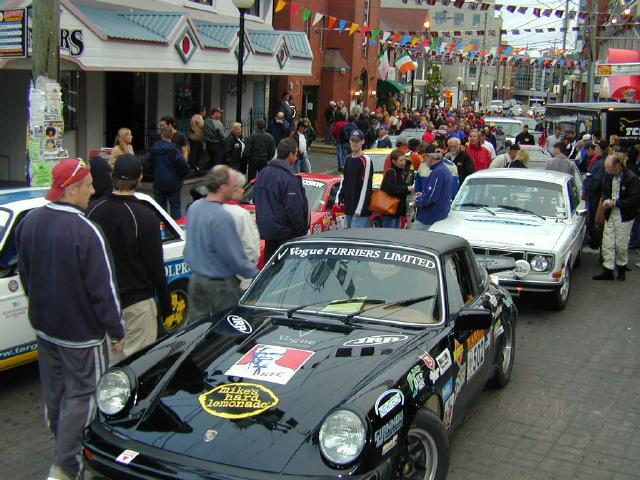
Today’s action consisted of the Demonstration, a nearly 2 km blast around the Confederation Building in St. John’s. It begins with a parade of the competing cars from Mile One Stadium in downtown to the complex of government buildings up on the hill. After a couple of parade practice laps to familiarize competitors with the course, they hit the track individually. The idea is for the event stewards to get an idea of driver ability… or lack thereof. Despite a few spins and some mechanical failures, there were no big incidents.
Action really begins on Monday with the Prologue stages. Results on these two stages will help organizers seed the drivers based on their ability. The first is 4.62 km, the second 7.06 km. In between is a two hour lunch break at Beachy Cove School.
We Got Screeched!
There is a tradition in Newfoundland to welcome visitors. It involves a sharp tasting rum called Screech, kissing a cod fish, and reciting a phrase in your best attempt at a Newfie dialect.
Following the Sunday evening dinner, Captain Merle showed up to tell a few stories about life in Newfoundland, and to baptize those “not from around here”. We kissed the cod (in this case, a slice of salt cod), gulped the Screech, and did our best recitation, and Captain Merle passed among the throng with oar in hand, tapping the newly-Newf-ed on the shoulder.
When one thinks of Newfoundland in September, one thinks of cool days and chilly nights, possibly rain and fog. Bright sun and high temperatures are unheard of… until this year. The Time and Temp clock on a local bank read 33 degrees, and that’s in Celsius, my son. (I’ve only been here a couple of days and I’m already picking up Newf chatter). That same clock registered 93F.
Today there were two stages, both considered “non-competitive”, but more like qualifying to establish position on the road. The slower cars start first, and the start intervals are only 30 seconds in order to keep the field bunched up.
The first was a short dash (less than 5 km) in a semi-rural area called Flat Rock. No big incidents, some spinning of tires, a few missed calls.
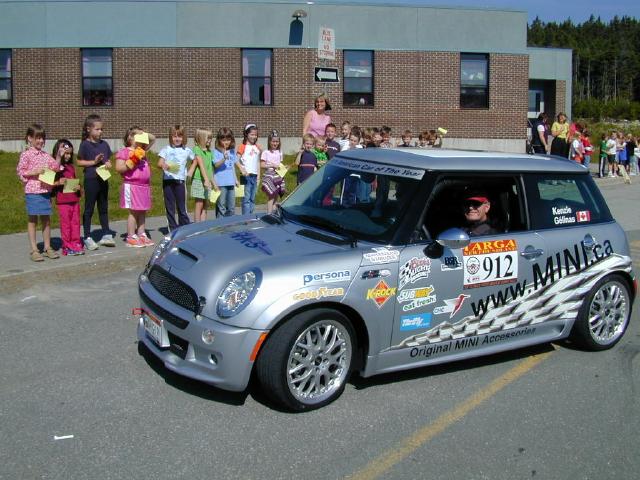
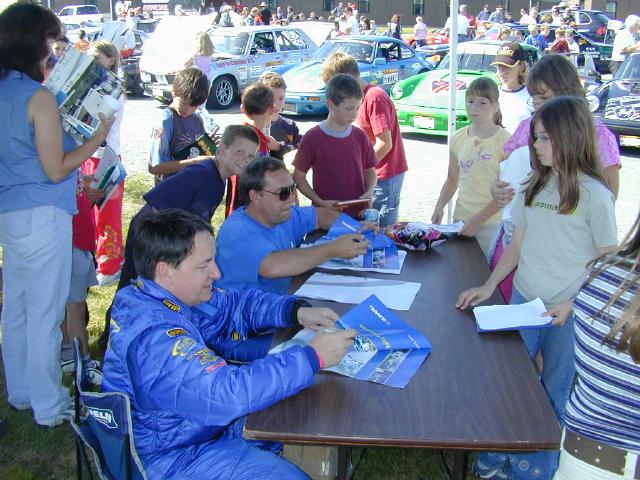
Lunch was a two hour break at Beachy Cove Elementary School. The students were given a reprieve from their studies to take a look at the fifty or so cars parked in the school’s front parking lot, while drivers and crews grabbed a bite in the gymnasium. As teams wandered back to their cars they were beseiged with requests for autograhs. Many came prepared with hero cards and decals (pronouced “DECK-els” in these parts, as opposed to the U.S. pronounciation of “DEE-kals”).
Then it was off for the other stage, a 7 km affair along Marine Drive. Several teams erred on this tight and twisting stage, including the favored Mustang of Formula Atlantic race driver Jeremy Hill and car owner Lennox McNeely. A front brake pad became dislodged as the car entered a right-hander and it left the road, eventually stranded with tail in the air and nose in the ditch. It is hoped the car can be repaired for Tuesday’s start, but the extent of damage had not been determined as of this writing.
John and Clark Paynter quickly established themselves as the front runners in the Subaru Canada Rally Team WRX wagon, setting fastest times on both Prologues. Bill Arnold was quickest in the Classic category in his BMW Bavaria, which hides a much newer “M” six cylinder under the hood. Daily results are posted at RallyScoring.com.
The real competition begins on Tuesday, with seven stages. The longest – Osprey Trail West – is 33.19 km, the shortest – Traytown West – is 3.84 km. Totals for the day: 360.80 km Transit, 77.46 km Stage. total 438.26 km.
Leg One – Persona North Avalon
Targa Newfoundland ’03 started out much like TN02… unfortunately. Two cars crashed out on the first stage, a short jaunt through a semi-rural neighborhood near St. John’s. The Cobra replica of Mark Armstrong came into the final turn at the Flying Finish a little too fast and went out of control, eventually landing in a ditch. Ken Bavis came into that same corner wa-a-ay too fast and rolled his Honda Civic. As a result, most cars had to transit the stage and it was not scored.
The damaged ’65 Mustang Fastback of Jeremy Hill and Lennox McNeely showed up for the start, looking a little battered and reportedly a little out of kilter underneath. They made it through the day without taking any points, however. The popular Mustang will make its way to a body shop in Gander (tonight’s overnight stop) for some frame straightening.
One of those favored to make a run for the top finishing spot was the mustard yellow Ruf Porsche GT of Gary Church and Bob Miller. However, the car did not make it to the final stage of the day due to a blown radiator hose. Jack MacDonnell and Carson Rasmussen thought they were out of the running before the first stage when the hydraulic clutch system on their Datsun 280Z failed. They were able to make repairs and rejoined the event for SS2. Since SS1 was dropped from scoring, they were allowed to continue without penalty.
There were no serious incidents on any of the remaining six stages. Several teams collected their first points on SS2, including the Subaru Canada Rally Team WRX of John and Clarke Paynter (1), and the Vermont Sports Car prepared WRX of Jerry Churchill and Jim Roxbury (4).
Targa Newfoundland scoring favors cars in the Classic category, requiring those who compete in Modern cars to work a little harder. The base times for each class are listed on the Individual Stage Scores, along with the penalty time over that base, and the time over the Targa Trophy Time.
Leg 2: CHC Exploits – Gander to Gander
Seven stages again today, including the now popular run to the little village of Leading Tickles. The first of the day began with a high speed section leading to the village of Norris Arm, with some tight twists through the streets and alleys of the town, and another fast stretch back out to the main highway.
Botwood traveled mainly through the town, with lots of quick turns on the town’s streets, and a long high speed stretch at the end.
There is only one road to Leading Tickles and it is closed to the public for the running of stages to the town and back again. The stage actually starts in the town of Point Leamington, then travels on the road to Leading Tickles, eventually ending up with a few hard turns in the town itself. The total stage length is nearly 30 km. Service crews are allowed to pass once the last car has cleared the stage.
This is followed by traditional Newfoundland lunch of Jiggs Dinner, Fish and Chips or Moose Soup. The break is welcome as the competitors get a chance to view the beauty of the area. Weather is sunny and hot once again, with temps ranging into the 30s C / 90s F. Those who make the climb to the top of the ridge report seeing whales off in the distance.
While part of the beauty of Targa Newfoundland is the scenery, eventually we all must climb back into the cars for the trip back to Point Leamington, again 30 KM, followed by the Botwood and Norris Arm stages in the reverse direction.
The final stage of the day is the run through a suburban housing development in Gander. Look for photos at www.targanewfoundlandgander.com. Only the Porsche 944 S2 of Craig Seko and Steve Carrick failed to complete the course, due to an electrical failure just meters from the finish.
Two more cars have suffered the ravages of Targa Newfoundland today: The Mini of Jim Kenzie and Gabriel Gelinas and the Citroen DS20 of Edison and Marg-O Wiltshire. The Mini had been prepared by a race shop, with low suspension and tires with very short sidewalls. It suffered two flat tires when Gelinas, who was driving that section, hit a pothole near the start of the 30 km run to Leading Tickles. With only one spare on board, it was determined that the long run would not be good on the car or rim, and they are out of the running for Targa, but will return in the Touring category.
The Wiltshire’s Citroen had a spark plug blow out of the head. They were able to limp back to Gander where a Heli-Coil was installed and they will be back on the road tomorrow.
Leg 3: Subway Kittiwake – Gander to Clarenville
The day opens with another run through the streets of Gander, this time in the opposite direction. Base times have been lowered, so drivers are concerned about picking up their first points, however, the stage is apparently quicker in this direction and twelve of the cars are able to beat their base time.
Following Route 330 north, there are several stages in the Kittwake peninsula. Davidsville, SS 3.3, is pretty straightforward, a 4.42 km fast stage on some bumpy pavement. The road from Fredrickton to Carmanville is next, 10.4 km with some tight turns in each town and some long fast stretches in between. Several teams pick up more points, some because of minor off-road excursions.
The rally takes a quick run through Musgrave Harbour before the lunch break at the Muddy Shag Lounge.
A new stage this year is in Greenspond, a typical Newfoundland fishing village a ways off the main road. As the route travels through the streets there are some very tight turns, some very steep uphill sections, and a very fast run to the finish line. It is here that Alan Ryall’s Subaru meets its end. Just after crossing the line at speed, Ryall let up on the accelerator and the car spun off the road, did a couple of endos and came to rest. Ryall and co-driver Glenn Hamilton were unhurt, though they were taken to a hospital to be checked out. Since the car is no longer driveable, they plan to return tomorrow for the Touring class in their service van.
The final two stages of the day, Traytown East and Port Blanford, are both about 4 km long and relatively fast.
The other casualty of the day was the Porsche 911S of Scott Giannou and Tim Winker. Giannou entered a marked right hand bend on SS 3.3 a little too quick. It turned out to be downhill and a little off-camber. He let up to scrub a little speed and the back end of the Porsche came around, coming to rest with the right rear fender pinched under a guardrail. The damage turned out to be all cosmetic and the team were able to continue following the lunch break. The team had been without penalty up to that point.
Leg 4: Thrifty Car Rental Heritage – Clarenville to Marystown
It’s a long two hour drive from Clarenville down the Burin Peninsula to the day’s first stage through residential Marystown. Once there, Targa drivers are treated to a course that travels past family homes, apartment buildings and some light industrial areas. At one point the route passes under a bridge packed with spectators, from which much of the course can be viewed.
The next stage has long flat stretches where cars can be wound out in top gear, but with a couple of tight turns in the villages of Garnish and Frenchman’s Cove. Stage 4.3 is 11 km of driving along a road cut into the rock face next to the ocean, ending with a drive through the town of Burin. Lunch is at the Old Colony trust building there, another great meal of typical Newfoundland fare.
After lunch we ran back out on the same stage that brought us into Burin, ending in Mortier. That was followed by two very tight town stages in Grand Bank (6.6 km) and Fortune (4.4 km). A feature of the Grand Bank stage is a short jaunt along the wharf where fishing boats tie up to unload their catch. Several cars oversteered onto the wharf, bumping rear tires against the concrete barrier that keeps things from rolling into the harbor. The BMW 2002tii of Jarvis and Jarvis slid straight into that barrier and bent the front suspension; the tii was out for the remainder of the event, but the team returned in a BMW X5.
The final two stages of the day were 4.2 and 4.1 run in reverse, ending at the hockey arena in Marystown.
It has been a day where mechanical fatigue is showing on many of the cars. Goeff Fowlow’s Jaguar XK-120 has suffered a water pump failure, and the alternator has given up on Ben Thomas’ Saturn. Both are able to make repairs and return later in the day, but have missed several stages and taken timing penalties. Tom Silver’s 1965 Mustang and Rick McLeod’s supercharged 2000 Mustang both show indications of blown head gaskets. Sean Hyland’s 2001 Mustang sounds like hell due to a hole in the headers. Jerry Churchill missed a turn in Marystown and has crunched up the front air dam on his Subaru WRX. The Honda CRX of Ian Crammond and Branko Brkovitch became locked in 2nd gear and the engine balked at running in the upper revs for long distances, eventually putting a connecting rod through the block. Several teams are having to replace expensive alloy wheels damaged by hitting curbs.
Local garages look like some sort of automotive triage, and many crews worked late into the night to stay in the running for the final run to St. John’s.
Leg 5: Goodyear Tire South Avalon – Marystown to St. John’s
Repairs have been made to most of the cars that suffered problems on yesterday’s run. Tom Silver’s Mustang has new head gaskets, but the team discovered a hole in a piston. Without sufficient time or parts to make proper repairs, the team has chosen to run the car on seven cylinders, disconnecting the spark plug wire on the damaged cylinder. The Brkovitch/Crammond Honda CRX has had an engine/gearbox transplant.
The final day of an endurance event like Targa Newfoundland is probably the most difficult. The target times have been lowered to be unreachable in most stages, so fatigued drivers have to push their fatigued cars as hard as possible to maintain position, or to move up. There is a tight battle at the front of the field between several teams, with only seconds separating them. Bill Arnold has the lead in his BMW Bavaria, but is pressured by the ’65 Mustangs of Jeremy Hill and Tom Silver, and by the ’67 Acadian Canso of Jud Buchanan.
It begins with a two hour transit back up the Burin Peninsula and a reverse direction run at the 36 km Osprey Trail stage from Leg 1. Then it’s down the Avalon Peninsula to Placentia for another run through the streets. The course is a bit different this year, with an added loop so speeds will be slower coming into the tightening right hander that took out the Datsun of Jack MacDonnell against the seawall last year. MacDonnell and most teams make it through relatively unscathed, though the Acura of Brian Oldford and John Harris collects a stop sign post with the bumper. Ralph Grant’s Volvo is temporarily sidelined with a broken throttle cable, costing Grant and co-driver Jodie Shay their plate for finishing all stages within the prescribed time. The Ruf Porsche of Gary Church suffers a suspension failure and is out of the event. Jerry Churchill’s run also comes to an end, as his Subaru WRX falls victim to mechanical woes.
Jack MacDonnell and Carson Rasmussen may have gotten past their bugaboo in Placentia, but the engine of the 280Z chose to give up a short time later on the long, fast stage to St. Bride’s.
The first stage after lunch is the longest of the event at 43 km. It is also very quick, with fast curves and mild hills, so the big concern is exceeding the 130 kph limit for average speed. A speed trap in mid stage catches a couple of cars for added penalty points, but all make it through no more teams dropping out. Another 12 km stage without incident, and it’s on to the final stage, the one that could decide the top five finishers.
The final stage is run partially through the town of Petty Harbour. The target times have been lowered so no one should be able to beat them, but they could come close. Jeremy Hill comes closest with on 8 second penalty in the Mustang, while Bill Arnold crosses the final Flying Finish with :11 in his Bavaria. In the final tally, only five seconds separate the two cars after five days of rally; Arnold with :38, Hill with :43. Jud Buchanan had been in second place going into the Petty Harbour stage, but 20 seconds of penalty time drop him to third in the overall result (:53), ten seconds behind Hill/McNeely and three seconds ahead of Silver/Fuss (:56). The top four are all in the Classic Category. Ernie Jakubowski and Scott Gerard round out the top five with 1:02, capturing first in the Modern category (1977 and newer).
The remaining cars regroup at Cape Spear, the easternmost point of North America, drivers congratulate one another on finishing, and all parade the 15 km back to St. John’s for prize giving. All teams who make it to the finish are given medals, those who have completed all stages in the prescribed time get plates. Most teams begin to make plans for 2004.
Epilogue: Targa Newfoundland 2003
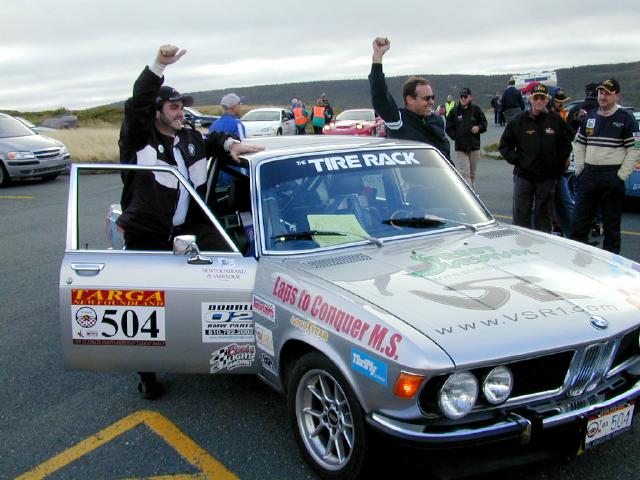
TN03 lived up to expectations, and in some cases exceeded them. There were few problems, and with the second running, Targa Newfoundland can now rightfully be called “Annual”. Plans have already begun for TN04, both on the part of organizers and competitors. There has been plenty of discussion among those who have been a part of the first two blasts around the rock, most of it centered around the proper strategy to be competitive on the week-long event, as well as how Targa could be tweaked to make it better still.
There are, of course, a few local naysayers, who were quick to point out the first day crashes and opined that all that display of speed would only lead to aggressive behavior on the highways by non-rallyists. Same can be said for aggressive behavior in hockey, football, baseball, or most any sport. Heck, even golfers, tennis and chess players get a burst of adrenaline once in awhile!
The numbers tell the story. Sixty competing teams, eager to complete the course at all costs. Teams who suffered terminal damage to their cars quickly regrouped and came back with service vehicles, running the remainder of the event as part of the Touring category, but running nonetheless. Thousands of people coming out to see the cars, on the stages, at the overnight stops, parked along the transit sections and waving as the parade of numbered machines drove past. The provincial government of Labrador and Newfoundland is happy to sponsor the event as it will bring an estimated five million dollars in tourism money to the area. And those motorsports fans who watch the one-hour TV program in Canada and on SPEED channel in the U.S. will get a chance to see the beauty and the friendly folks that are standard fare in Newfoundland.
There really is no event quite like Targa Newfoundland. It is part rally, part race, part scenic tour, part car show in action, part floating party. It’s sort of like running an entire season of amateur competition in one week. Targa Tasmania and Targa New Zealand have been around long enough that they are now dominated by a few teams with lots of money and support, but Newfoundland is still new enough that any amateur motorsports team can be competitive. Sure it takes a fast, reliable car, an able driver and an equally able co-driver, but at the end of the week most novices can easily see where they could run with the front pack with a bit more work.
And everyone starts to make plans to be back next year….
Complete results at RallyScoring.com